


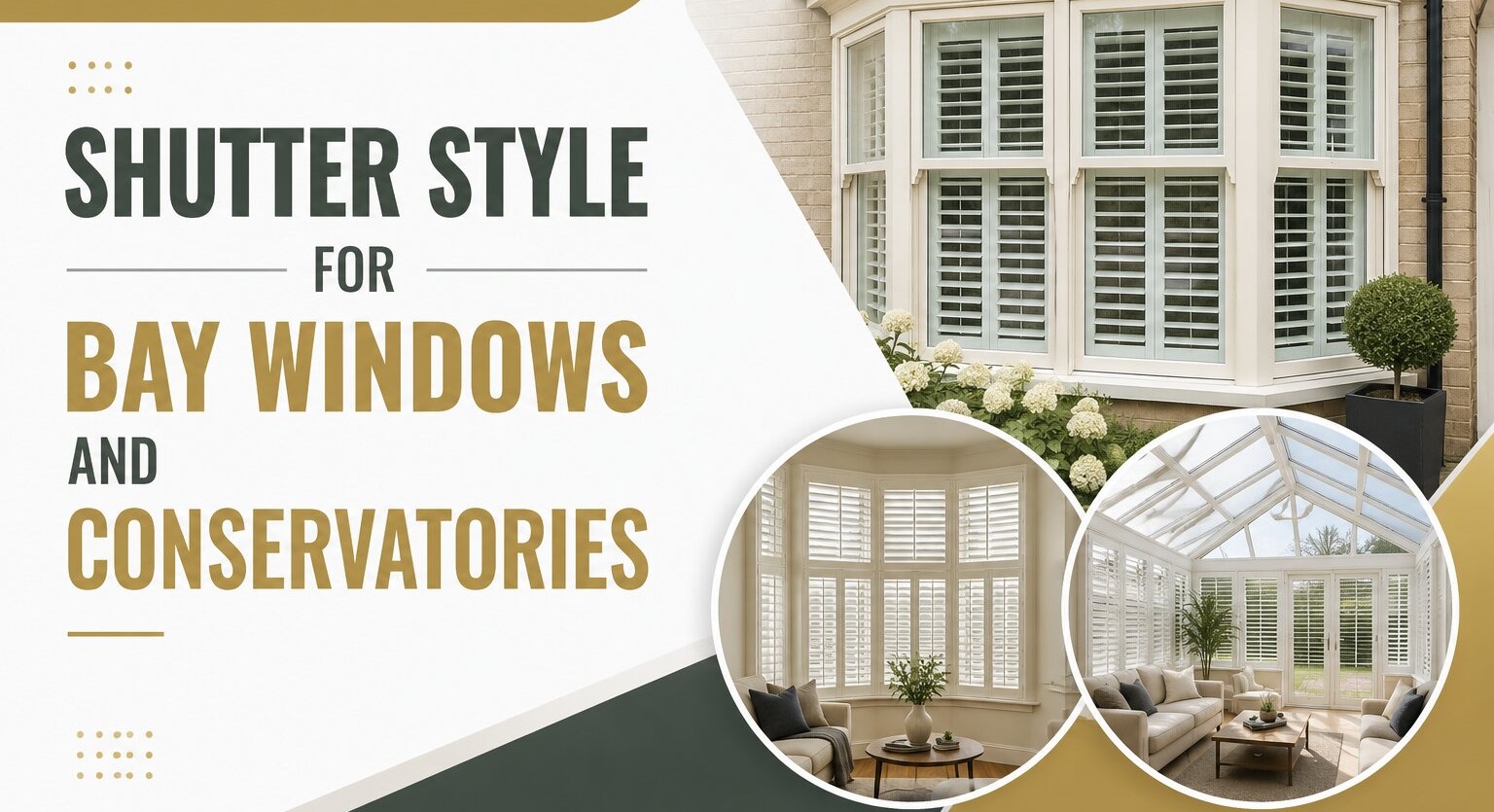

Bay windows and conservatories are two of the trickiest spaces to dress well. Bay windows demand precision fitting across angles and sections, while conservatories need materials and louvre styles that handle heat, glare, and moisture. This guide walks through every major shutter style, what works where, and what to watch out for — so you can make a confident, informed decision.
Bay windows and conservatories tend to be the rooms people love most in their homes. They’re bright, characterful, and full of potential. They’re also the spaces that catch people out when it comes to window dressings.
Standard blinds often look a bit “stuck on” in a bay. Curtains can make a conservatory feel stuffy and dated. And ordering something online without a proper measure? That’s a gamble that rarely pays off. Shutters, done well, are one of the most effective solutions for both spaces — but only if you choose the right style, material, and configuration for the job.
At Art Blinds, we’ve been measuring, fitting, and advising on made-to-measure shutters across Hadleigh, Southend-on-Sea, Leigh-on-Sea, Westcliff-on-Sea, Chalkwell, Rayleigh, Basildon, and the wider Essex area for over 50 years. We’ve seen what works and what doesn’t in every type of home. This guide pulls together everything we’d tell you in person — before a single measurement is taken.
What makes bay windows and conservatories different?
Bay windows: angles, projections, and sightlines
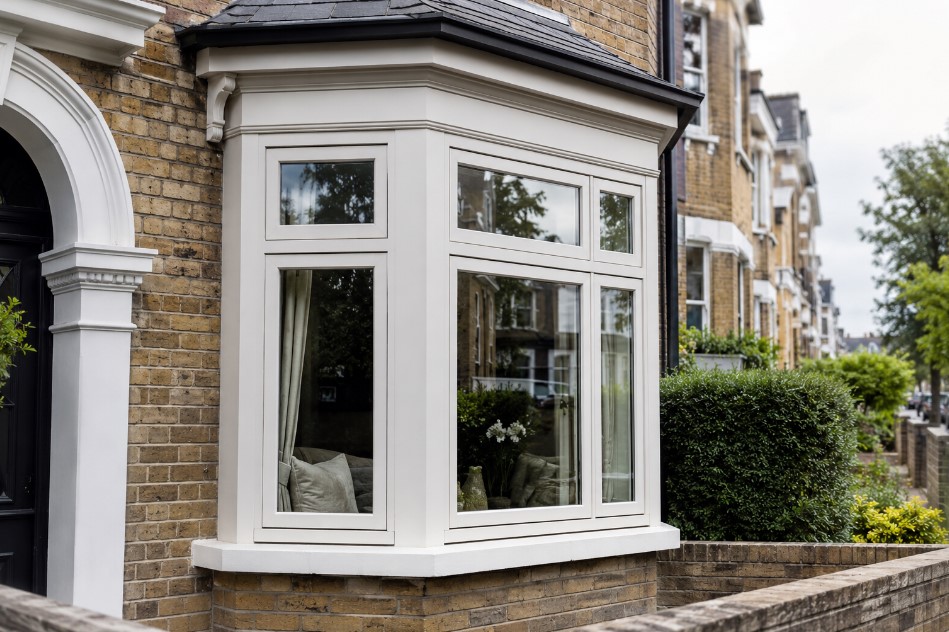
The main challenge with a bay window isn’t aesthetic — it’s structural. A bay typically consists of multiple panes set at unique angles to one another, which means shutters need to be planned section by section. Templates help find the exact meeting points of bay window angles. Each individual section has to sit correctly within the window frames to achieve a perfect fit across the bay, whether you’re dealing with box bay windows or another layout. Get the angles wrong (even slightly) and you’ll end up with panels that don’t sit flush, gaps at the corners, or a finished result that looks uneven from the street.
And that kerbside view matters. Shutters on a bay window look genuinely stunning from outside — crisp, consistent, high-end. But achieving that look requires the right style choice and precise fitting. It’s one of the reasons we always carry out a professional measure before anything is ordered.
Street-facing bays also raise real privacy questions, especially in living rooms. During the day, light floods in beautifully. Come evening, the dynamic flips entirely — you need a solution that keeps your living room from feeling like a goldfish bowl.
Conservatories: heat, glare, fading, and ventilation
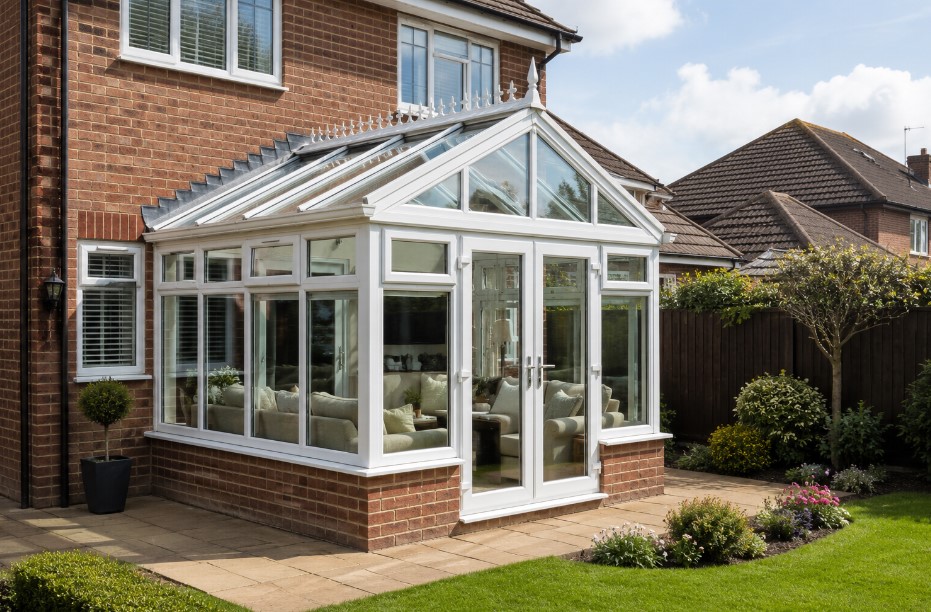
Conservatories present a different set of challenges altogether. South-facing glazed rooms can hit temperatures that make them unusable in summer, though well-chosen shutter blinds can support energy efficiency by helping regulate temperature year round. Sunlight fades furniture, scorches plants, and bounces off TV screens at every angle. And because conservatories tend to be full of glass — roof, walls, doors — any window dressing needs to work around access points and ventilation without becoming a daily inconvenience.
Material choice matters enormously here, especially across large conservatory windows. Standard wooden shutters can warp or crack under sustained heat and UV exposure. Shutters provide insulation, help control heat, and can keep a conservatory cool in summer while making the space more usable in winter and cooler months. That can help maintain a comfortable temperature and reduce energy bills. And if your conservatory gets humid (plants, cooking smells drifting through, occasional condensation), moisture resistance becomes just as important as aesthetics.
Bay window shutters in the UK: styles that work (and why)
Full height shutters
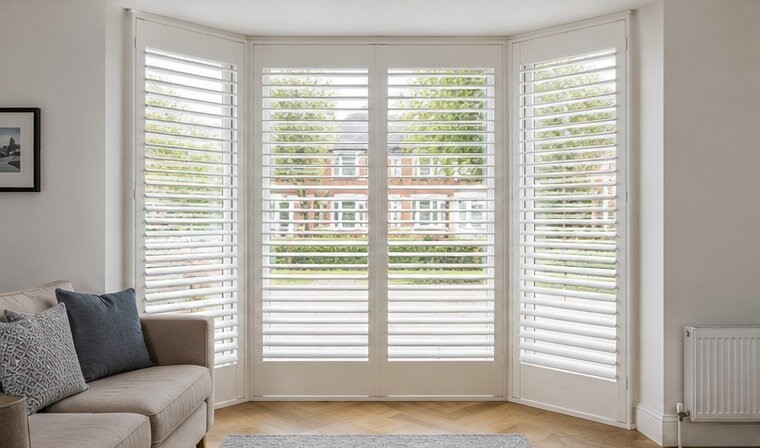
Full height shutters run from floor to ceiling (or sill to top of the frame) in a single panel, covering the entire window. They give the most seamless, architectural, elegant look — particularly effective on larger bay sections or traditional-style homes.
Best for: Clean sightlines, strong kerb appeal, and homes with a period feel.
Watch out for: Make sure mid-rails line up neatly across the angled sections of the bay. A misaligned mid-rail across multiple panels is one of those things that sounds minor until you’re looking at it every day.
Tier-on-tier shutters
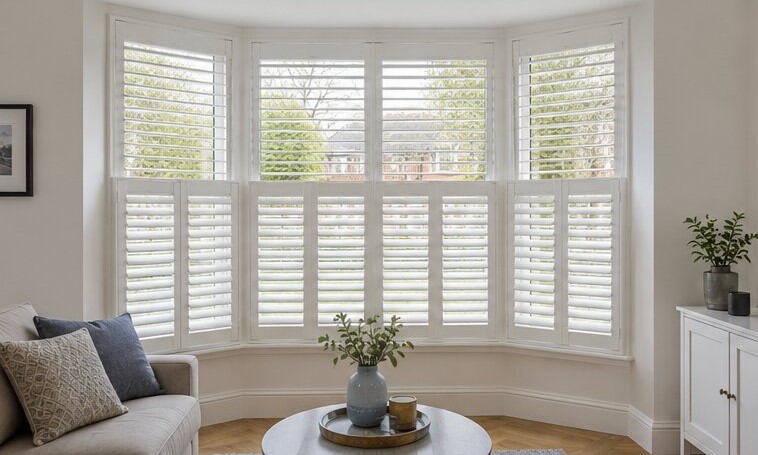
Tier-on-tier shutters split each panel into two independently operated halves, with independent top and bottom shutter panels helping balance light and privacy. Open the top, close the bottom. Close both. Open both. The flexibility is genuinely useful.
Best for: Front-facing bays where you want privacy at ground level without blocking natural light from above.
Worth knowing: Tier-on-tier tends to cost a little more, but for a street-facing bay, the ability to keep the windows open while adjusting the top and bottom sections separately is often worth every penny.
Café style shutters
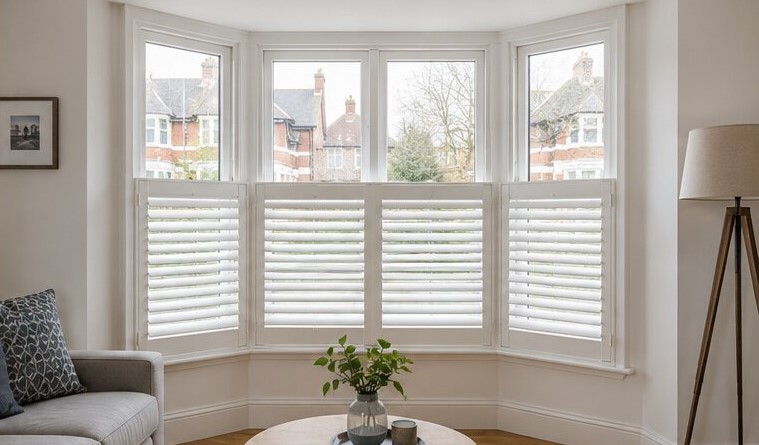
Café style shutters cover only the lower portion, or bottom half, of the window, leaving the top open. Think Parisian brasserie — and yes, they work just as well on a semi-detached in Essex, allowing natural light through the upper section while maintaining privacy below.
Best for: Bright rooms where you want to keep the light but don’t want passers-by peering in; a stylish choice of window coverings when you want less bulk than curtains, since shutters fitted within the frame take up less space.
Watch out for: At night, with the lights on, the top half of the window is fully exposed. If full privacy after dark is a priority, café style alone won’t cut it. Consider a blind for the upper section if needed.
Tracked shutters for wide bays
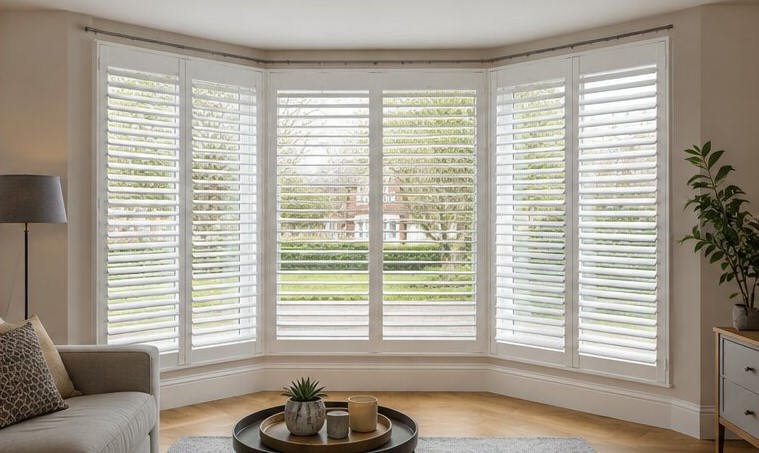
For wider bays, or bays that incorporate a door or access point, tracked shutters are worth considering. Rather than hinged panels, they slide along a track — keeping things practical and avoiding panels that swing into walkways.
Best for: Large bay configurations, bays near patio doors, or anyone who needs panels to move out of the way quickly and cleanly.
Shaped and arched shutters
Some bay windows have unusual tops — curved arches, pointed sills, box bays, or non-standard frames. A shaped shutter, made precisely to those dimensions, keeps the look cohesive where an off-the-shelf option simply can’t.
Best for: Character homes with unconventional window shapes. Key point: Made-to-measure is absolutely non-negotiable here, and often the perfect solution for unusual shapes. There’s no workaround for a badly fitted shaped shutter.
Best shutters for conservatories: what to prioritise
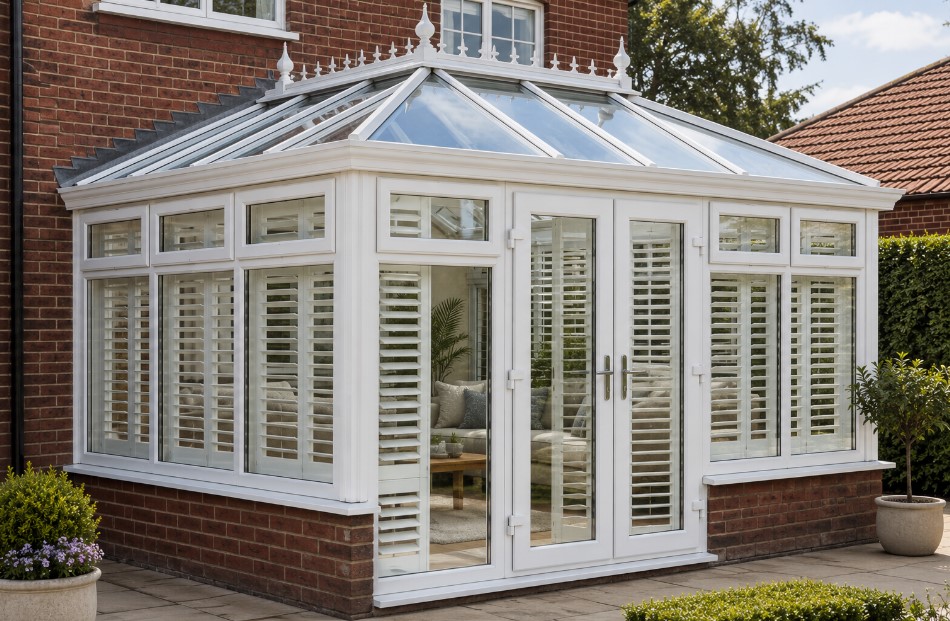
Material matters more in conservatories
In a standard room, the difference between real wood and faux wood (ABS) shutters is largely aesthetic. In a conservatory, it becomes a practical decision.
Real wood can expand, contract, and warp under sustained heat and UV exposure. Faux wood or moisture-resistant alternatives hold their shape and colour far better in high-sun environments, and they’re much easier to wipe clean. For most conservatories, we’d recommend moisture-resistant or faux wood shutters as the default — they look just as good and last considerably longer.
Light and heat control options that actually help
One of the genuine advantages of shutters for a conservatory over most other window dressings is the slats. Being able to tilt them means you can redirect sunlight — bouncing it up toward the ceiling rather than straight at your face, or your sofa, or your TV — which improves light and privacy while helping maintain a comfortable temperature throughout the year.
For ventilation, louvres can be opened just enough to let a breeze through while still maintaining privacy, which makes different shutter styles more practical across changing seasons. That’s a balance most blinds and curtains struggle to strike. If glare is the primary concern, a mid-range louvre size (around 63–89mm) tends to offer the best combination of view, light control, and airflow.
Doors, handles, and daily access
It sounds obvious, but it’s worth planning carefully: how do you get in and out of your conservatory? Where are the door handles? Are there opening vents low down on the glazing?
Shutters that clash with door mechanisms, block ventilation panels, or make it awkward to get outside are going to frustrate you quickly. When you choose shutters, account for access, ventilation, security, and appearance. When we carry out a measure, we always map access points and plan panels around them as part of our service — it’s the kind of detail that makes the difference between shutters that look good and shutters that work brilliantly every day, and well-planned layouts can also act as a barrier to potential intruders without getting in the way of daily use.
How to choose the perfect shutter style for bay windows: a quick decision guide
Not sure where to start? Use this as your shortcut:
- Maximum privacy at all times → Full height or tier-on-tier
- Bright room + privacy at street level → Café style or tier-on-tier (top open, bottom closed)
- Wide bay or bay with a door → Tracked shutters
- Traditional home, clean look → Full height with a classic louvre size and paint finish
- Angled or unusually shaped bay → Made-to-measure shaped shutters (don’t attempt a workaround here)
- Period property → Wider louvres, off-white or warm-toned finishes tend to sit beautifully
The perfect shutter style for bay windows genuinely depends on your specific window configuration, your privacy needs, and how much light you want to let in. That’s exactly the kind of conversation we have during a measure — it doesn’t need to be figured out in advance.
Design choices that change the whole look
Louvre size
Larger louvres (89mm or more) give wider, more open views and work well in modern, contemporary spaces. Smaller louvres (47mm) suit period properties and more traditional aesthetics. The size also affects how much light comes through when the shutters are open — worth testing in person before you decide.
Colour and finish
Bright whites and off-whites are the most popular choice in the UK — they’re clean, versatile, and look sharp in almost any space. For period homes, a warm off-white or bone finish can feel more sympathetic. For conservatories, lighter colours help keep spaces feeling cool visually, even on a blazing July afternoon.
Frame types and sightlines
The frame is what anchors the shutter to the wall. A well-chosen frame makes shutters look genuinely built-in rather than added-on. It’s a small detail that has an outsized impact on the overall finish.
Measuring and fitting: where most mistakes happen
Bay windows require angle measurements that standard tape measures don’t handle well. Each section of the bay needs to be measured independently, and the angles between sections need to be recorded precisely. A fraction of a degree out across three sections adds up — and results in panels that don’t align.
Conservatories have their own traps: door frames that aren’t perfectly square, glazing bars that complicate panel placement, and roof sections that affect light at different times of day.
Professional fitting isn’t just about convenience. It’s about getting a result that looks intentional and works properly. We’ve been doing this across Essex for decades, and we still find something worth noting on almost every measure — something that would’ve caught out an online order or a DIY fit.
If you’d like us to carry out a measure and talk you through your options in person, we’re happy to do that with no pressure attached. Pop into our showroom in Hadleigh, give us a call, or get in touch via our contact page and we’ll take it from there.
FAQs
What’s the best shutter style for a bay window that faces the street?
Tier-on-tier shutters are usually the most practical choice for a street-facing bay. They let you open the top panels for light while keeping the bottom panels closed for privacy — which is exactly what most front-facing rooms need. Café style is another option if you don’t need full coverage.
Are shutters suitable for conservatories that get very hot in summer?
Yes, but material choice is crucial. Real wood can warp under sustained heat and UV exposure, so moisture-resistant or faux wood (ABS) shutters are generally the better option for conservatories. The louvre tilt function also helps redirect direct sunlight without blocking airflow.
Can I have shutters on angled bay window sections without gaps?
Yes — with a proper made-to-measure approach and precise angle measurement, shutters can be fitted neatly across angled sections. The key is an accurate professional survey before ordering. Gaps at corners are almost always the result of incorrect measurements or off-the-shelf solutions forced into bespoke spaces.
Do café style shutters work in bays?
They work very well in bay windows, particularly those that get a lot of natural light. The open upper half keeps the room bright, while the lower panels maintain privacy from the street. The trade-off is that at night, with the lights on, the top half of the window offers no privacy — something worth considering if your bay is in a well-lit street.
What material is best for conservatory shutters?
Moisture-resistant or faux wood (ABS) shutters are the most practical choice for conservatories. They handle heat and humidity better than real wood, hold their colour under UV exposure, and are simple to clean. If you have a more shaded or north-facing conservatory, real wood can work well — it’s worth discussing during a survey.
Will shutters make my room darker?
Not significantly, when fitted correctly. With the louvres open, shutters let in a generous amount of light. The adjustment comes from being able to control exactly how much light you want and from which direction — which most rooms benefit from, rather than suffer.
Can shutters be fitted to uPVC bay windows?
Yes. Most made-to-measure shutters can be fitted to uPVC frames, either directly or via a timber sub-frame. A proper measure will identify the best fixing method for your specific window and frame type.
How long does measuring and installation take?
A measure typically takes 30–60 minutes depending on the number of windows. Lead times for made-to-measure shutters vary, but we’ll give you a clear timeline from the outset. Installation usually takes a few hours to get shutters fitted in one room, and our fitters tidy up fully before they leave.
Are shutters easy to clean in a conservatory?
Very. A quick wipe with a damp cloth is usually all it takes. Moisture-resistant shutters are particularly low-maintenance in conservatory environments, where dust and the occasional condensation patch are common.
Do you offer made-to-measure shutters and fitting in Essex?
Yes — we supply and fit made-to-measure shutters across Hadleigh, Southend-on-Sea, Westcliff-on-Sea, Leigh-on-Sea, Chalkwell, Rayleigh, Basildon, and the surrounding areas in Essex. Get in touch and we’ll arrange a free survey and measure at a time that suits you.
Ready to find the right shutters for your home?
Bay windows and conservatories aren’t straightforward spaces — but they’re exactly the kind of project we enjoy. The right shutter style, fitted well, genuinely transforms both rooms: the curb appeal of a bay, the livability of a conservatory, the sense that a home has been finished properly.
If you’d like tailored advice on what’d work in your space, we’re here. You can visit our showroom on London Road in Hadleigh to see finishes, louvre sizes, and materials in person — or get in touch by phone or via our website contact form and we’ll arrange a free, no-obligation measure at a time that suits you.
We’ve been helping Essex homeowners get this right for over 50 years. We’re happy to help you too.
